

What is a Liquidity Pool in Cryptocurrency
If you want to understand how a liquidity pool works and how it differs from a traditional order book, this article will help you understand it in simple terms. You'll learn how AMM market makers work, what solutions exist, what risks to consider, and how to get started?
Why Do We Need a Liquidity Pool?
A liquidity pool is a common reserve of tokens locked in protocol code that allows exchanges to occur without directly matching buyers and sellers. Thanks to this decentralized trading mechanism, operations happen quickly, and fees are distributed among providers who supply assets on the blockchain. A user who adds funds receives pool tokens — these are receipts reflecting your share and entitlement to a portion of fees. This approach makes DeFi ecosystems more accessible, reduces slippage, and supports listing new tokens without centralized approval. Liquidity pools in cryptocurrency help markets operate stably even under increased load.
The Difference Between a Liquidity Pool and a Traditional Order Book
In an order book, price is formed by orders placed by market participants — liquidity appears and disappears depending on trader activity. In an AMM, instead of an order book, you interact with a formula and asset reserve, and AMM makers don't place limit orders. This ensures continuous exchange and predictable pricing but shifts attention to the model's features and risks like impermanent loss. As a result, liquidity pools are suitable for a wide range of pairs, including new cryptocurrencies.
How Does a Liquidity Pool Work?
The mechanism is built around a mathematical rule and a set of incentives. You add two assets in a certain proportion, receive tokens, and then liquidity providers earn a fee from each trade proportional to their contribution. Parameter management is often implemented through a DAO — token holders vote on fees, listings, and development. Where liquidity is important for user onboarding, liquidity pools receive special attention.
Automated Market Maker (AMM)
AMM is an algorithm that calculates price based on the balance of assets in the reserve. The most well-known formula is constant product, where the product of the quantities of two assets in the reserve remains constant. Thanks to this, exchange is always possible, and market makers don't maintain an order book or manual accounting. In decentralized finance, this approach lowers barriers to entry and simplifies cryptocurrency operations.
Liquidity Mining and Yield Generation
You provide liquidity and earn fees from exchanges, sometimes additional rewards in the form of farming. Yield depends on trading volume, fee levels, and the amount of attracted funds. The higher the turnover, the faster your share of fees accumulates, but the pair's volatility affects the final result. For tracking results, it's convenient to use dashboards for liquidity pools and reports on pairs.
Governance and Voting
Many protocols put important parameters to a vote — token holders can adjust fees, launch incentives for reserves, and choose where new markets will be deployed. This helps maintain a balance of interests between traders and providers, as well as direct the ecosystem's development.
Smart Contract Insurance
Network vulnerabilities are one of the key concerns. Insurance solutions are emerging to cover risks in protocol smart contracts. Users can purchase policies to reduce the impact of technical failures or audit errors, and projects can increase audience trust. Risks of smart contracts during updates and migrations should be considered separately.
Creating Synthetic Assets
Based on reserves, it's possible to issue derivatives and synthetic assets that track the value of real instruments. This expands the range of strategies, from hedging to arbitrage, and opens the way to more complex markets on top of the base AMM model.
Main Types of Liquidity Pools
Below are the key varieties found on popular DEXs. They differ in pricing formulas and purpose, which is important to consider when choosing a strategy.
Constant Product Pools
This classic approach works well for volatile pairs. Liquidity pools using this model ensure continuity of exchanges, but strong price imbalances can lead to impermanent loss for providers. Arbitrageurs help return the price to market level, profiting from the difference.
Stablecoin Pools
For similarly priced assets, formulas with less slippage are used. In such pools, it's easier to maintain accurate exchange rates, making them attractive for high volumes and integration with payment solutions. Liquidity pools are more convenient for maintaining minimal deviations.
Smart Pools
These are adaptive solutions where parameters, asset weights, and fees can change dynamically. This type of liquidity pool is often used for index baskets and rebalancing — users get convenient access to asset bundles.
Lending Pools
Here, funds are placed for collateralized loans. Income comes from interest, and borrower availability depends on collateral ratios and risk levels. Such models are often combined with AMM in complex DeFi protocols.
Algorithmic Pools
Experimental constructions with alternative price curve functions — for example, with concentrated ranges. This type of solution requires more precise settings and monitoring but increases capital efficiency with competent position management.
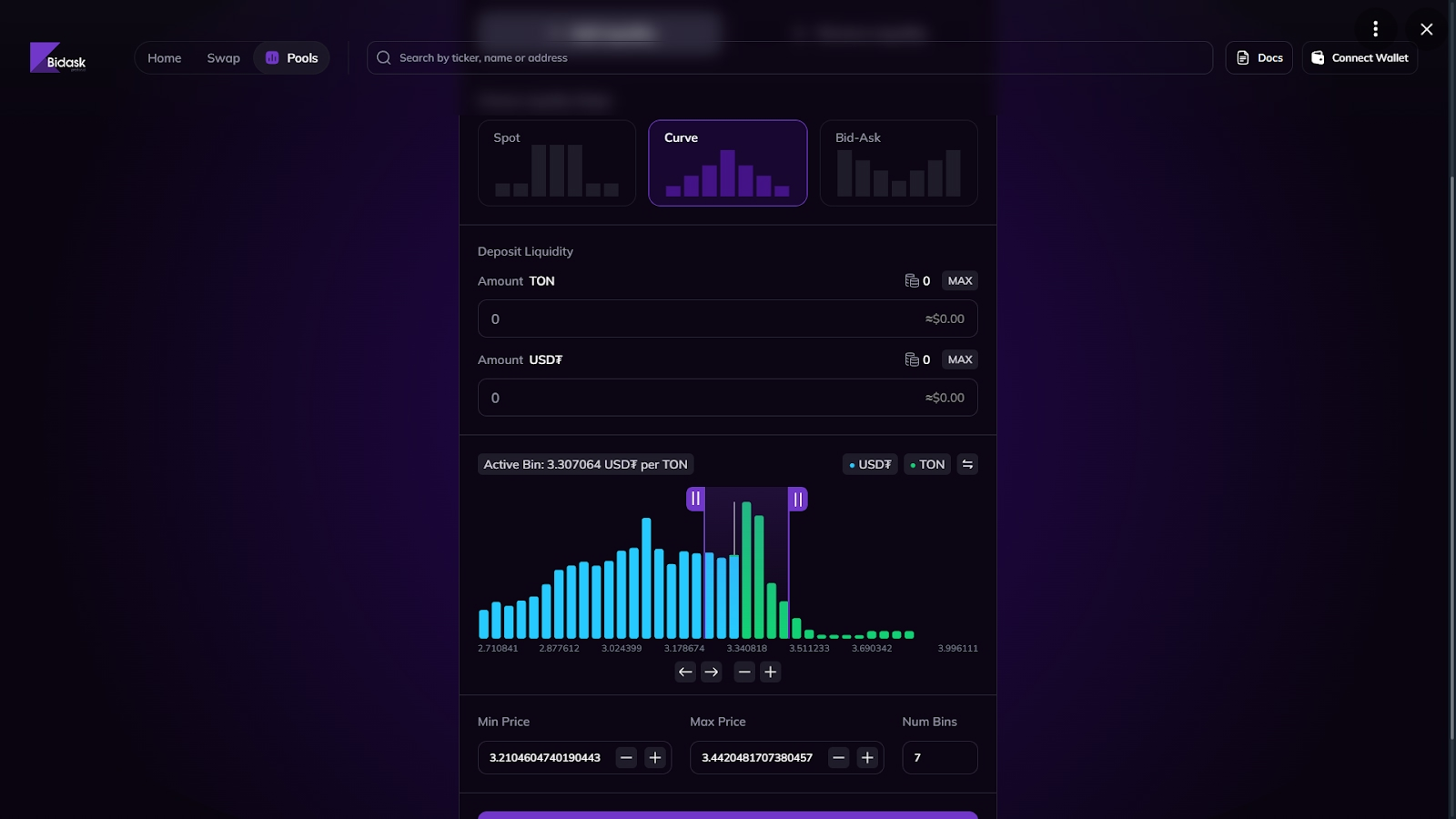
The latest protocols, such as "Bidask" on the TON blockchain, implement the concept of concentrated liquidity. This allows capital efficiency to be increased many times over. Liquidity pools created this way require fewer funds to provide the same trading volumes as classic AMMs. In liquidity pools with concentrated ranges, funds work more precisely.
How to Participate in a Liquidity Pool?
Below is a step-by-step example on "Bidask" so you can get started without unnecessary mistakes and understand the process logic. Anyone can become a provider. To put it simply, you act as a technological exchange office, providing a reserve for transactions. A liquidity pool is accessible in the interface in just a couple of clicks.
How to Make Your First Swap
Show steps
- Connect your wallet
- Choose a trading pair (for example TON/USDT)
- Specify how much you want to exchange token A for token B
- If everything is done correctly - you will see the expected exchange price and other transaction details
- Click "SWAP" and confirm the transaction in your wallet
- Wait for the exchange to complete
How to Add Liquidity to a Pool
Show steps
- On the main page, select the Pools section
- Choose a liquidity pool suitable for you
- On the pool page, click "Add liquidity"
- Choose the form of liquidity provision (Curve, Spot, Bid-Ask)
- Enter the amount of tokens you want to use
- Double-check the entered data and select the price range
- Click "Add Liquidity" and confirm the transaction in your wallet
How to Launch Your Meme Token on Bidask
Show steps
-
Open the "MEMES" section — On the main application page, click on the "MEMES" tab.
-
Click "Create a Meme" — In the upper right corner, you will find a button to create your token.
-
Fill in the basics — Provide all necessary information: upload a Logo, come up with a Name and Ticker.
-
Choose exclusivity (optional) — You can select the "Exclusive listing only on Bidask" option (if this option is active, the token cannot be added to another DEX).
-
Fill the project page — Add a description, banner, and links to your social networks (X, Telegram).
-
Configure the launch — Choose the trading start time. You can launch the token immediately or set a delayed launch.
-
Set up the initial buyback — Choose the percentage of total supply you want to buy back. This amount (in TON) immediately goes into the liquidity pool, ensuring its depth at the start.
-
Set the starting price — Choose the price at which trading of your token will begin.
-
Final check — Carefully double-check all entered data. Make sure the ticker, name, and links are correct.
-
Confirm the launch — Confirm all necessary transactions in your wallet.
The Uniqueness of "Bidask" Protocol and DAMM/DLMM Technologies
"Bidask" is not just an exchange, but a protocol on TON using advanced asset management algorithms.
DAMM: a dynamic AMM model that adapts to market conditions and maintains balance even with high volatility.
DLMM: a mechanism that allows placing funds not across the entire price curve from zero to infinity, but in specific price intervals, or bins. Thanks to this, your liquidity in the pool works exactly where trading occurs, increasing capital efficiency. The liquidity pool collects fees more easily with the right range selection.
Choose a Platform
- Check the audit, reputation, and protocol documentation.
- Compare pairs, depth, fees, and incentives.
- Evaluate wallet support and interface convenience.
Prepare Your Wallet
- Install a TON-compatible wallet, such as "Tonkeeper".
- Save your seed phrase offline and don't share it.
- Make sure you have the correct network and gas limits.
Choose a Token Pair
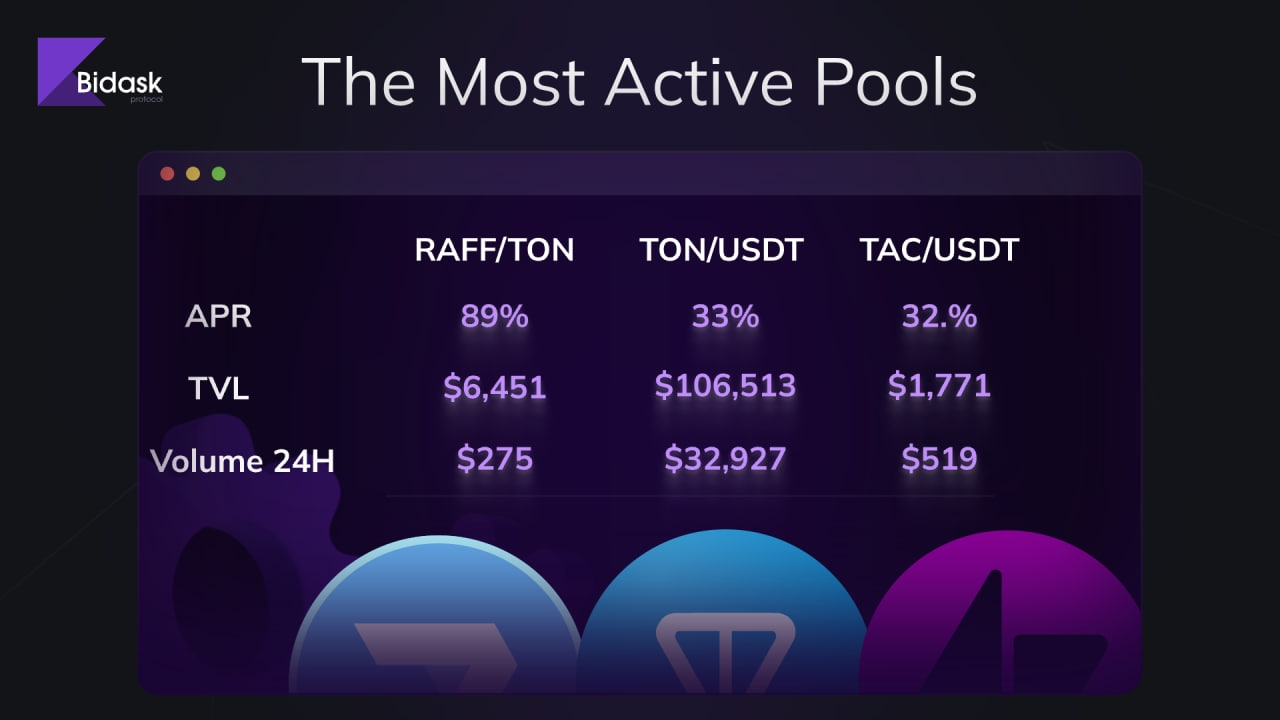
- Study the APY and trading volumes for the selected pair.
- Evaluate the reliability of the coin pegged to cryptocurrency.
- Consider the volatility and correlation of assets.
Add Liquidity
Go to the "Bidask" interface. Specify the number of tokens and, importantly for DLMM, select a price range. After confirming the transaction, your funds will go to the liquidity pool. In return, you will receive confirmation of your share, and the smart contract will start generating fees for each exchange that occurs within the selected range. To control parameters, use the section with your position in the liquidity pool.
"Bidask" and Token Launch Without the Pain
With a recent update, "Bidask" has made launching your tokens and creating a liquidity pool even more pleasant. The meme pad helps creators by solving typical launch problems:
- protection from sniping at launch using Antisniping;
- profitable liquidity, where locked funds continue to work and generate fees;
- media support — AMA sessions and cross-posts for your project.
Stop struggling with problems alone — launch on a platform created for your success.
Risks and Challenges of Liquidity Pools
When investing, it's important to understand income sources and risk factors. Below are key points to pay attention to before depositing funds. Liquidity pools provide opportunities but require discipline.
Impermanent Loss
⚠️ IMPORTANT
This is the most common risk for providers. Impermanent loss occurs when the price of tokens in the reserve changes significantly compared to the moment they were deposited. If you had simply held coins in your wallet, their dollar value could have been higher than when withdrawing from AMM. The loss becomes real only at the moment of withdrawal, and fees and incentives partially compensate for the effect.Setting Price Range in a Liquidity Pool
In concentrated liquidity protocols like "Bidask" or "Uniswap V3", the user chooses the price corridor in which their funds work. If the price goes beyond the range, the position stops participating in trading and doesn't generate fees, and the balance may shift toward one asset. This requires more active management and periodic rebalancing.
Smart Contract Risk
⚠️ IMPORTANT
Even the most reliable code can contain vulnerabilities. Hackers are constantly looking for loopholes to withdraw funds, and an error in the logic of one component can lead to capital loss. Always check for audits, use insurance, and diversify positions between protocols. Additionally, evaluate contract risks during upgrades.Centralization Risk
Administrative keys and the ability to make urgent upgrades create additional risk. Scenarios are possible when attackers gain access to keys; when unscrupulous developers orchestrate a rug pull; when sudden parameter changes limit the operation of reserves. Study multisig mechanisms, timelock procedures, and voting reports.
Future and Development of Liquidity Pools
Technologies don't stand still. We see the emergence of hybrid models like DLMM on TON that combine the advantages of order books and AMM. Institutional investors are also beginning to show interest in cryptocurrency — this requires creating more regulated and secure platforms. Also expected is the growth in popularity of derivatives and options in DeFi, where "Bidask" and similar protocols will play a key role thanks to capital efficiency.
In conclusion, it's worth noting that liquidity remains the circulatory system of decentralized finance. Understanding the principles of AMM and new models like DAMM opens wide opportunities for passive income. The evolution of smart contracts and interfaces makes the tool increasingly accessible, and new contracts are becoming more reliable. By providing necessary liquidity to the pool, you become part of the infrastructure of the future, and liquidity pools help the market become more efficient through strategy competition.
Practical Recommendations
Expert advice
- Start with small amounts and test the platform interface to understand fees and confirmation speed.
- For first steps, choose pairs with stablecoins — volatility is lower, drawdowns are compensated by fees.
- Monitor trading volumes and depth — activity increases your share of fees and execution quality.
- Diversify strategies and protocols — distribution reduces the impact of single events.
- Use audits, insurance, and permission reviews — this increases the base level of protection.
Bidask
Protocol Team
Frequently Asked Questions
How is AMM different from an order book? The pricing algorithm replaces the order book, and exchange occurs with the reserve, not with a counterparty.
Who are providers? These are users who provide liquidity and receive fees proportional to their capital.
How to understand your share? It's shown by pool tokens — when withdrawing, you receive the corresponding part of the reserve and fees.
Can you lose funds? Risks exist — from impermanent loss to technical problems; reduce them through diversification and monitoring.
What affects profitability? Trading volume, protocol fees, pair volatility, and ecosystem incentives.
Glossary in Simple Terms
Pool Tokens — Receipts confirming your share and giving the right to redeem part of the reserve.
Market Makers — Participants who increase exchange availability by placing assets in reserves.
Decentralized Trading — A transaction format without an intermediary, managed by code and protocol rules.
Impermanent Loss — The difference between the value of a position in the reserve and simply holding assets outside the protocol.
Smart Contract — A program on the blockchain that automatically executes protocol rules and fee calculations.
Legal and Technical Reminder
- Check wallet and network compatibility — a network error leads to irreversible fund transfer.
- Clarify taxation of operations in your jurisdiction — rules change.
- Store seed phrases offline and use hardware devices — this is the base level of protection.
From General to Specific: How to Act Today
- Define the goal — fees from exchanges, farming, or an index basket.
- Choose a pair — start with a stablecoin position and practice deposit and withdrawal.
- Document steps — record date, amount, pair, fee, and addresses.
- Monitor metrics — trading volume, APY, price change, and reserve distribution.
- Adjust strategy — when volatility increases, expand the range or change tactics.
Comparison with Competitors
Study educational materials from major platforms — they help you understand AMM mechanics more deeply, how liquidity pools work, and evaluate fee models. The better you understand reserve construction and incentives, the more effectively you'll build your approach and reduce risks.
Important Security Nuances
- Code audit doesn't exclude bugs — use protocols with bounty programs and open development.
- Avoid phishing — check URLs and transaction signatures, don't grant unnecessary permissions.
- Limit access — periodically revoke rights from DApps if they're no longer needed.
Liquidity pools are the foundation of DeFi. By understanding AMM mechanics and new models like DAMM and DLMM, you can leverage the advantages of decentralized exchanges, earn fees, and support market development while controlling risks and improving strategy. The liquidity pool remains a key tool for the growth of the cryptocurrency ecosystem.


